
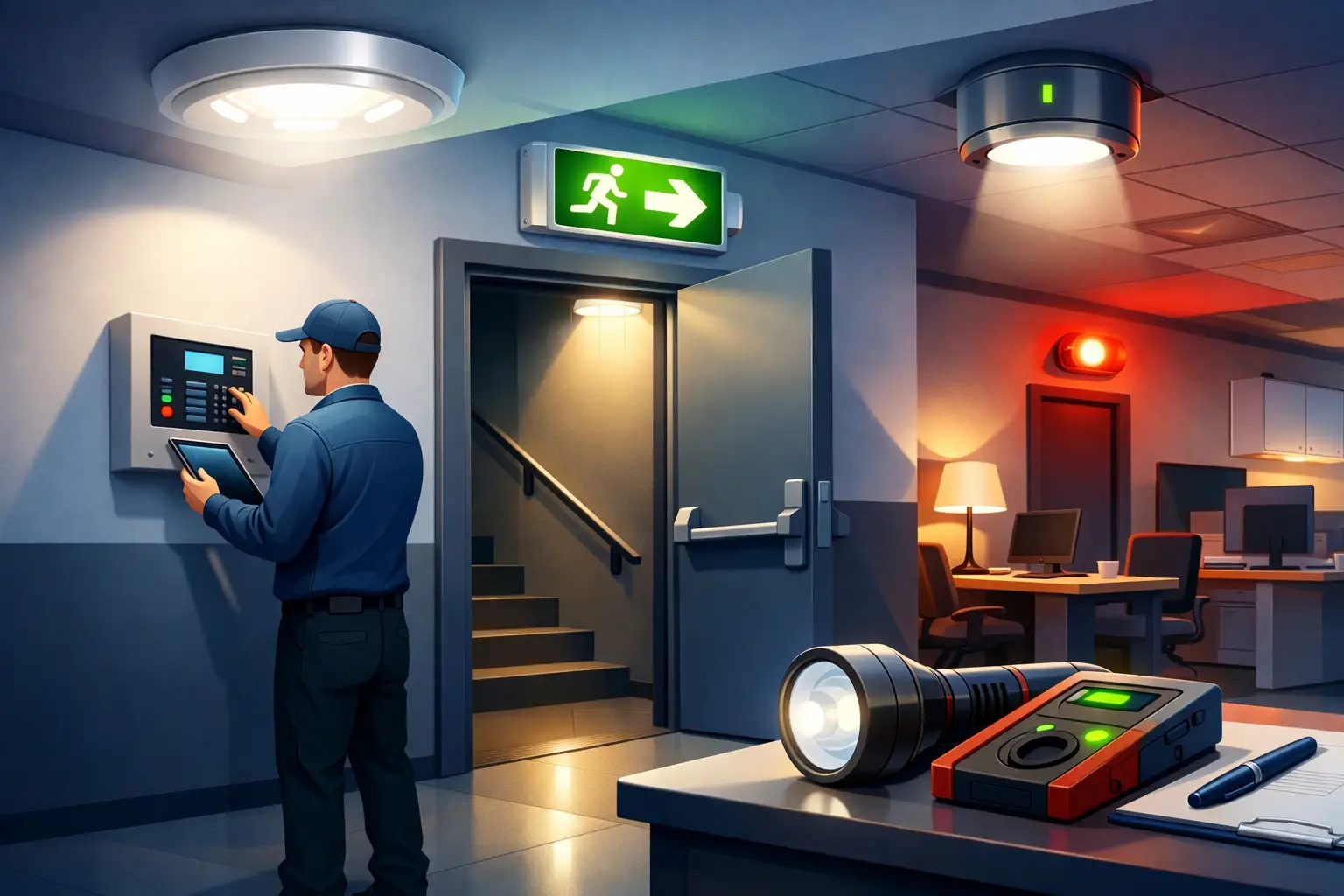
Commercial Emergency Lighting Testing Explained
A mains failure can turn a familiar office, warehouse or communal corridor into an unsafe environment within seconds. Commercial emergency lighting testing confirms that escape routes, fire exit signs and open areas remain adequately illuminated when normal lighting fails - not simply that the fittings look acceptable during normal operation.
For property owners, facilities managers and responsible persons, this is a practical safety duty with clear operational consequences. A failed battery, damaged fitting or incomplete test record can leave people without a safe route out and create avoidable questions following an inspection or incident.
What commercial emergency lighting testing involves
Emergency lighting is designed to operate automatically following the loss of the normal lighting supply. Depending on the installation, this may include maintained illuminated exit signs, non-maintained emergency bulkheads, recessed fittings, central battery systems or self-contained units with individual batteries.
Testing checks that the system performs when it is needed. This goes beyond pressing a test button at random. A proper regime considers whether fittings illuminate, whether their batteries support the required duration, whether signage remains visible and whether faults are identified, recorded and corrected.
The requirements should be considered alongside the building's fire risk assessment and the applicable British Standards, including BS 5266. In England and Wales, the Regulatory Reform (Fire Safety) Order 2005 also places responsibilities on the person with control of non-domestic premises to maintain suitable fire precautions. The precise approach can vary by building use, occupancy, layout and the emergency lighting design.
Why visual checks are not enough
Emergency luminaires are often overlooked because they are designed to sit quietly in the background. A green indicator light may suggest that a fitting has power, but it does not prove the lamp will operate correctly on battery power or that the battery has enough capacity for a sustained evacuation.
Battery condition is a common issue. Batteries naturally degrade over time, particularly where fittings are exposed to heat, poor charging conditions or long periods without meaningful testing. LED fittings may use less energy than older units, but they still rely on a healthy charging circuit, battery and control gear.
A system can also be compromised by building changes. New partitions can obscure an exit sign, a change in room layout can alter an escape route, or a refurbishment can leave an area with inadequate coverage. These are reasons to review emergency lighting after alterations rather than treating it as a fixed, fit-and-forget installation.
The usual testing schedule
A proportionate routine combines frequent short tests with a longer duration test. The building's documented fire safety arrangements and equipment instructions should always be checked, particularly where there is a central battery, automatic test system or specialist installation.
Monthly functional tests
Monthly checks normally involve a brief simulated failure of the normal lighting supply. The purpose is to confirm that emergency fittings and signs operate and that there are no obvious faults or damaged units.
The test needs to be long enough to verify operation without unnecessarily discharging the batteries. For many properties, this can be carried out using a test key switch. In larger or more complex buildings, testing may be managed through a dedicated panel or automatic monitoring system.
After the test, the person carrying it out should make sure that the normal supply has been restored and that fittings return to charge. Any unit that fails to illuminate, shows damage or does not recharge correctly should be logged for remedial work.
Annual full-duration tests
The annual test is more demanding. It simulates a prolonged loss of normal lighting to establish whether the system can operate for its specified emergency duration. Three hours is common in many commercial installations, although the required duration should be confirmed from the system design, risk assessment and relevant standards rather than assumed.
This test needs planning. Carrying it out during business hours can leave areas with depleted emergency lighting while batteries recharge. In a building with late trading, shift work, vulnerable occupants or complex access arrangements, an out-of-hours test may be safer and less disruptive.
Once the test is complete, every relevant fitting should be checked. A luminaire that illuminates at the start but fades before the end has not passed the test. The system must then be allowed adequate time to recharge before relying on it again.
What a competent test should identify
Commercial emergency lighting testing is valuable because it exposes faults before an emergency does. During testing and inspection, common findings include failed lamps, exhausted batteries, damaged diffusers, missing test keys, poor labelling, unsuitable placement and signs that are no longer visible from the escape route.
It may also reveal circuit issues. Emergency lighting must be arranged so that the loss of a normal lighting circuit does not leave the relevant route in darkness. Where electrical alterations have taken place, changes to circuit arrangements, protective devices or local switching can affect how the emergency system responds.
For self-contained fittings, repairs may be limited to replacing a battery or driver where suitable parts are available. For older fittings, replacement can be the more sensible option. The right decision depends on the age of the installation, compatibility of components, condition of the fitting and the cost of repeated call-outs. Replacing a single failed unit is not always enough if several fittings of the same age are approaching end of life.
Keep records that stand up to scrutiny
A test without a record is difficult to evidence later. An emergency lighting logbook should show the date and time of the test, the type and duration, the person who completed it, results, defects found and the action taken to resolve them.
Clear records help a facilities team spot recurring faults and demonstrate that maintenance is being managed. They also make handovers easier when a tenant, managing agent or responsible person changes. Where defects cannot be repaired immediately, the record should show the interim action taken and the date remedial work is scheduled.
Automatic test systems can reduce the manual workload, but they do not remove the need for oversight. Fault reports still need review, physical damage still needs inspection and failed components still need correcting. Technology can support compliance; it cannot replace responsibility for the condition of the installation.
Testing alongside wider electrical work
Emergency lighting should not be considered in isolation from the rest of a building's electrical infrastructure. A rewire, consumer unit change, office fit-out, warehouse racking installation or partitioning project can all affect escape routes, circuit arrangements and the suitability of existing fittings.
When electrical work is planned, it is sensible to assess the emergency lighting at the same time. This can prevent a newly altered area from being handed back with poor coverage, obscured signage or a testing arrangement that is difficult to operate. It also reduces the risk of conflicting work, such as decorating or ceiling alterations damaging fittings shortly after they have been inspected.
OIT Limited can support commercial clients with electrical inspection, testing, certification and practical remedial work, helping keep safety-critical systems aligned with the wider condition of the premises.
When to arrange professional support
Routine monthly checks can often be completed by a trained, appointed member of staff in a straightforward property. However, professional support is particularly useful where the installation is large, the system has recurring faults, records are incomplete, the building has changed use or an annual duration test needs careful co-ordination.
It is also worth arranging an assessment if emergency lighting has not been tested for some time. Starting with a clear condition check, an asset list and a realistic remedial plan is more useful than assuming the entire system must be replaced. The aim is safe, reliable illumination where people need it, backed by records that show the work has been done properly.
If your last full-duration test is unclear, do not wait for a fire risk assessment review or a failed inspection to find out what is missing. A planned test and prompt repair programme gives your people a safer route out when normal lighting is no longer available.


Comments